
Island homes, raised houses and mainland Galveston County
Spray Foam Insulation in Galveston, TX
Insulation built for Gulf heat, salt air and humidity, with closed-cell foam where water and wind demand it and simpler materials where they do the job.
- Free estimates after we see the space
- Written quotes listing foam type, thickness and R-value per area
- Moisture, flood damage and air leaks checked before anything is covered
Spray Foam Insulation for Galveston's Climate
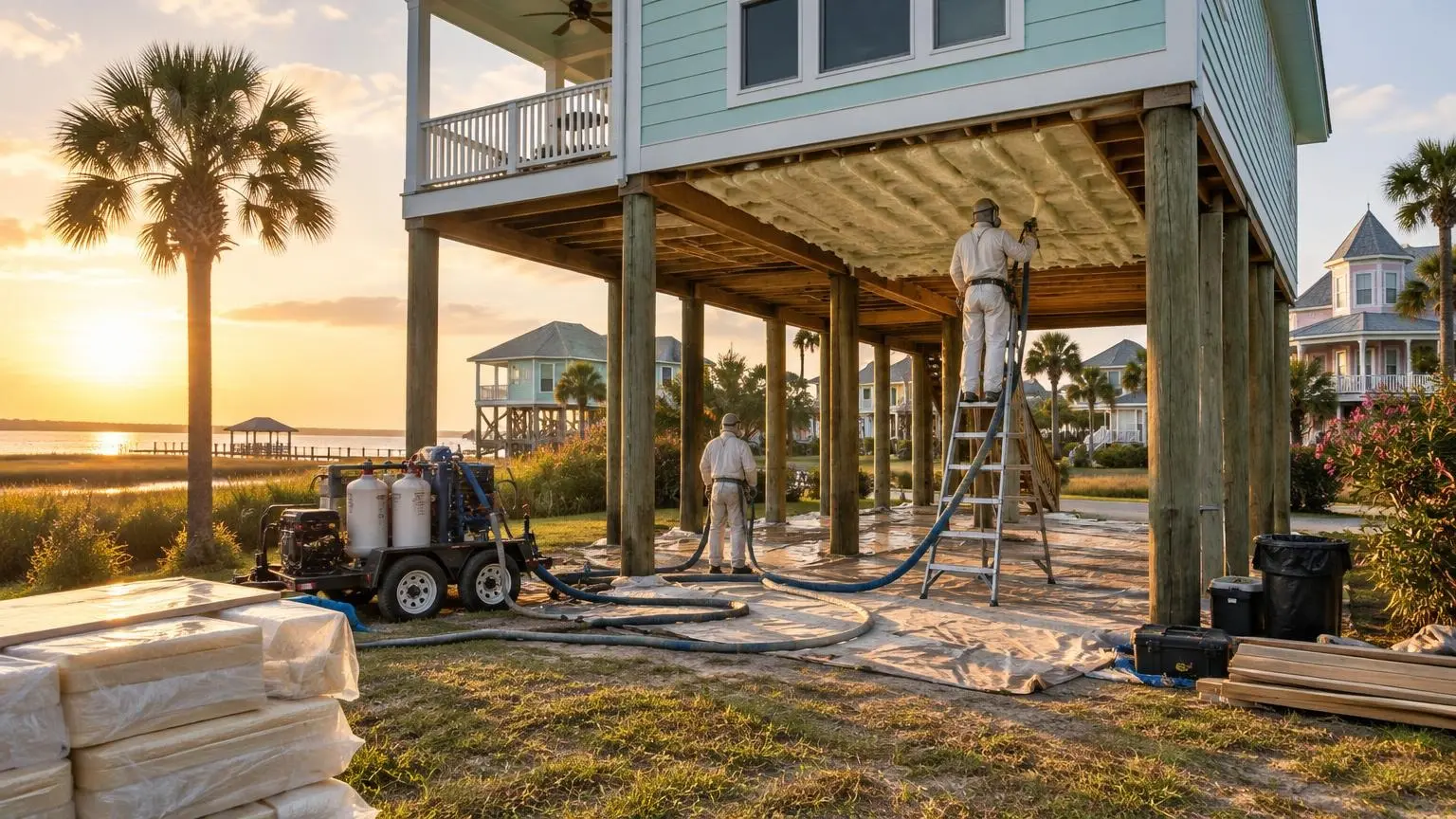
Spray foam insulation in Galveston has a different job than it does inland. Wikipedia describes the island's climate as humid subtropical, with summer days regularly above 90F, nighttime lows around 80F and steady south and southeast winds carrying Gulf moisture ashore. Annual precipitation averages about 47 inches. Cooling and dehumidifying run most of the year, so the insulation and air sealing in a Galveston home are mainly about keeping heat and moist air out. We seal the leaks and insulate with open-cell or closed-cell foam where it makes sense, and with blown-in insulation where it reaches the same result for less.
What the Texas code asks for
OpenEI lists Galveston County in Climate Zone 2A. Texas applies the 2015 IECC with state amendments, effective September 1, 2016, according to the Insulation Institute's Texas summary, which lists R-38 for ceilings and R-13 for wood-frame walls in Zone 2. Cities can adopt stricter codes. For existing attics, the Department of Energy suggests R-49 to R-60 in Zone 2 when the attic is empty, or adding R-38 to R-49 over 3 to 4 inches of existing insulation, and R-13 for an uninsulated floor.
Raised homes and floors open to the wind
Raised houses are a familiar sight on the West End, at Jamaica Beach and along the Bolivar Peninsula, and FEMA notes that most of Tiki Island's roughly 950 homes stand on tall concrete pilings. The floor of those homes faces outdoor air on its underside, often with salt-laden wind blowing through. Batts stapled under the joists sag, get wet and blow loose. Closed-cell spray foam on the underside of the subfloor, or between the joists behind a protective covering, holds up much better because it sticks, seals the air and does not absorb water.
Attics, ducts and roof decks
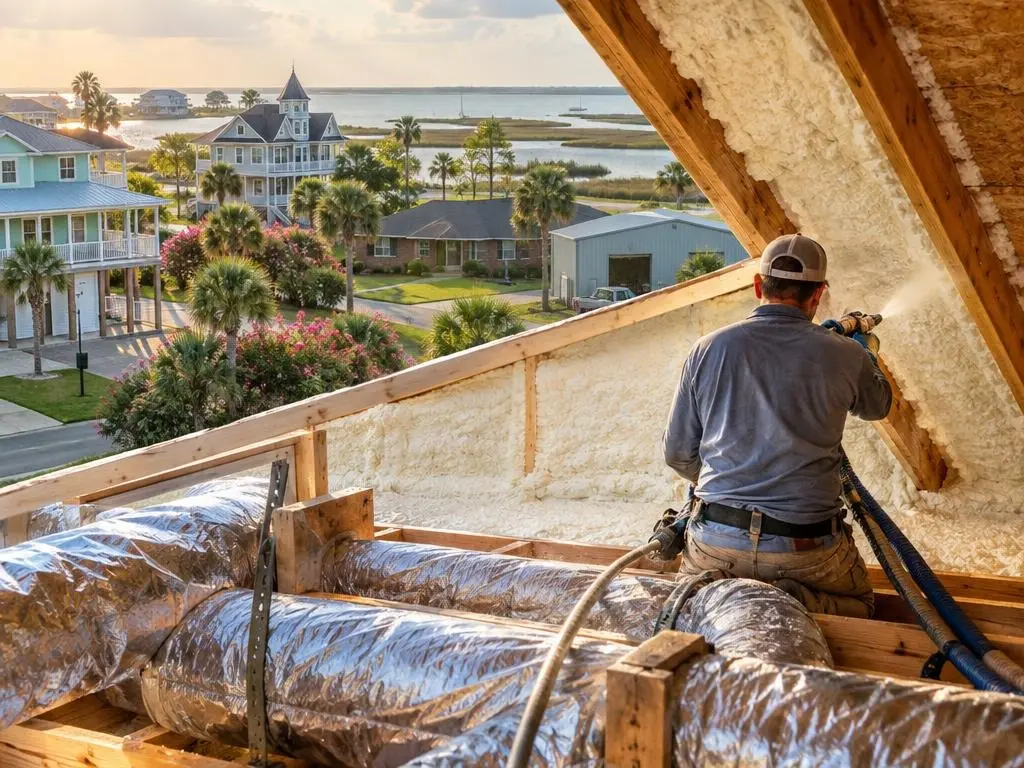
In many Galveston County homes the air handler and ducts sit in a vented attic that can run far hotter than the outdoor air in summer. One option is to seal the ceiling and blow insulation deeper on the attic floor. Another is to spray foam on the underside of the roof deck, which brings the attic inside the building envelope so the ducts sit in cooler, drier air. We explain which fits your house and roof.
Closed cell vs open cell on the coast
Open-cell foam is soft and vapor-permeable, rated about R-3.5 to R-3.7 per inch by HomeGuide. It works well in walls and on many roof decks. Closed-cell foam is dense, rated about R-5 to R-7 per inch, resists water and adds rigidity. On the coast we lean toward closed-cell for raised floors, areas below base flood elevation, metal buildings and anywhere water could reach the foam. Your quote names the foam for each area and why.
After a storm
Hurricane Ike made landfall on Galveston Island in September 2008 as a Category 2 storm, and Harvey's rain flooded thousands of mainland homes in 2017. When water reaches insulation, it usually has to come out. Wet batts and loose fill hold water against framing, and open-cell foam soaks up water. We remove damaged material, let the structure dry, and reinsulate with materials suited to the risk.
Spray foam insulation cost
HomeGuide's 2026 guide puts installed spray foam at $1.50 to $5.00 per square foot overall: open-cell at $1.50 to $3.50 and closed-cell at $3.00 to $5.00. About 1,000 square feet of foam runs $1,500 to $5,000, a whole house $8,000 to $20,000, and many installers have a job minimum of $1,000 to $2,000 or more. Fixr's 2025 figures for existing homes are $3.15 to $7.50 per square foot. For a 2,000 square foot house, the cost depends on which surfaces get foam, not the floor area, which is why we measure first. The written estimate is your price.
Choosing among insulation contractors and companies
When you call spray foam insulation contractors or insulation companies in Galveston County, ask each one the same things. What gets sealed before insulating? Which foam goes where, and why? What thickness and R-value will be written on the quote? How will the attic or roof deck be ventilated or sealed? How will wet or damaged insulation be handled? How long should everyone stay out after spraying (HomeGuide advises 24 hours or more)? A company that answers clearly, in writing, is easier to compare. If your search for spray foam insulation near me turns up vague answers, keep looking.
Why Homeowners Call Spray Foam Insulation Galveston
Written, itemized quotes
Material, thickness, R-value and price for every area so bids can be compared fairly.
Built for coastal moisture
Closed-cell foam where water, wind and salt air reach the insulation.
Damage found before covering
Roof leaks, wet framing and flood residue are pointed out before we insulate.
The right material, not just foam
We recommend blown-in where it reaches the target for less.
Common Questions
How much should I expect to pay for spray foam insulation in Galveston?
Published national ranges are $1.50 to $3.50 per square foot for open-cell and $3.00 to $5.00 for closed-cell (HomeGuide, 2026), with many installers setting a $1,000 to $2,000 or higher minimum. Your total depends on the surfaces sprayed and the thickness. We measure and give you a written price.
How much does spray foam insulation cost for a 2,000 sq ft house?
HomeGuide puts a whole house at $8,000 to $20,000 and Fixr at $10,000 to $30,000. The range is wide because a 2,000 sq ft house can have very different amounts of roof deck, wall and floor area to foam.
How much does spray foam cost for 1,000 square feet?
HomeGuide lists about 1,000 square feet of spray foam at $1,500 to $5,000, and Fixr lists $3,150 to $7,500 in an existing home. Thickness and foam type move the number.
Why is spray foam insulation now a red flag for some buyers?
Concerns usually involve foam on a roof deck that hides leaks or rot, or poor installs that leave odors. Those are installation and moisture issues. We inspect the roof and framing first and explain where foam belongs.
What is the best insulation under a raised floor in Galveston?
Closed-cell spray foam is usually the strongest choice under a floor open to wind and moisture, because it adheres, seals air and does not absorb water. Batts under raised floors tend to sag and get wet.
Does insulation have to be replaced after a flood?
Insulation that got wet usually needs to come out so the framing can dry. Closed-cell foam that stayed intact may not, but we check it. Wet batts, loose fill and open-cell foam generally get removed.
Should I foam my roof deck if my ducts are in the attic?
It is often a good option. Foam under the roof deck brings the attic into the conditioned space so the ducts are in cooler air. We check the roof first and compare it with sealing and insulating the attic floor.
What R-value does Texas require for attics?
The Texas code summary from the Insulation Institute lists R-38 ceilings in Climate Zone 2, which includes Galveston County. The Department of Energy suggests more for existing attics.
Where We Work
We work across Galveston Island, from the East End historic districts to the raised homes of the West End and Jamaica Beach, and on the Bolivar Peninsula from Port Bolivar to Crystal Beach. On the mainland we serve Tiki Island, Hitchcock, La Marque, Texas City, Santa Fe, Dickinson, League City, Friendswood, Kemah, Clear Lake Shores, Bacliff and San Leon. The island and bay communities mean raised homes, salt air and flood rules; the mainland means slab homes, ducts in hot attics and neighborhoods that flooded in Harvey. Each town page covers what is different there.
- Spray Foam Insulation in Galveston, TX
- Spray Foam Insulation in Jamaica Beach, TX
- Spray Foam Insulation in Bolivar Peninsula, TX
- Spray Foam Insulation in Tiki Island, TX
- Spray Foam Insulation in Hitchcock, TX
- Spray Foam Insulation in La Marque, TX
- Spray Foam Insulation in Texas City, TX
- Spray Foam Insulation in Santa Fe, TX
- Spray Foam Insulation in Dickinson, TX
- Spray Foam Insulation in League City, TX
- Spray Foam Insulation in Kemah, TX
- Spray Foam Insulation in Clear Lake Shores, TX
- Spray Foam Insulation in Bacliff, TX
- Spray Foam Insulation in San Leon, TX
- Spray Foam Insulation in Friendswood, TX
What We Insulate
Six services for coastal homes and buildings, each quoted in writing after we measure.
Spray Foam Insulation
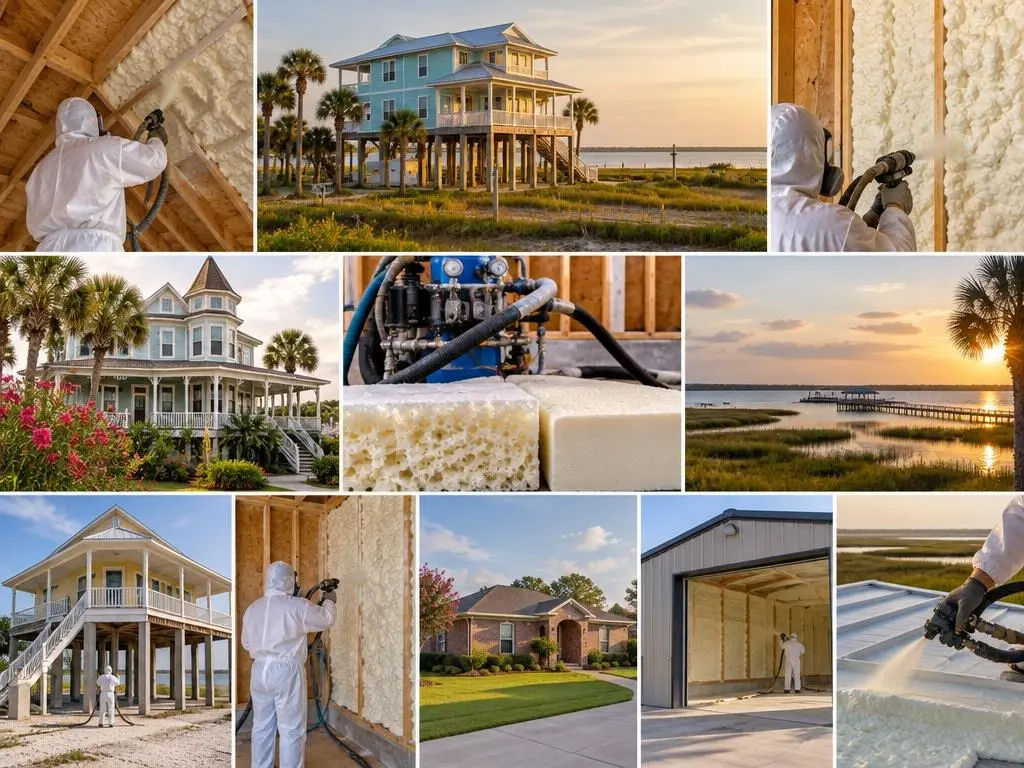
Open-cell and closed-cell foam for roof decks, raised floors, walls and metal buildings, chosen for each surface.
Learn more →Attic & Roof Deck Insulation
Seal and insulate the attic floor, or foam the roof deck so ducts sit in cooler air.
Learn more →Raised Home & Under-Floor Insulation
Closed-cell foam under floors of homes on pilings and piers, built to handle wind, salt air and moisture.
Learn more →Wall Insulation
Dense-pack blown insulation for closed walls in older homes and spray foam for new framing and additions.
Learn more →Metal Building & Shop Insulation
Closed-cell foam inside steel buildings, shops and garages to stop condensation and heat gain.
Learn more →Insulation Removal & Replacement
Removing storm-soaked, moldy or pest-damaged insulation and replacing it with the right material.
Learn more →Get a Spray Foam Insulation Estimate in Galveston
Tell us about the house and what is bothering you. We will measure, explain the options and put the price in writing.